Click the picture below to access parent website : www.hbjcapital.com / www.hbjcapital.in

Click the picture below to access parent website : www.hbjcapital.com / www.hbjcapital.in
Call : 09886736791 / 9677088836 (Multibagger) / 9818866676 (Penny) / 9886403791 (Trading)

Wednesday, April 8, 2009

Growth at a Reasonable Price (GARP Investing)

As its name suggests, the GARP Strategy works on the belief that the best way to generate high investment returns is to identify companies growing at high rates (like growth investors), which are trading at cheap valuations (like value investors). This philosophy is derived from the investment philosophy and writings of Peter Lynch (the manager of the Fidelity Magellan fund from 1979 onwards, for 14 years). Peter Lynch delivered returns at a rate of 29% CAGR during his tenure at Fidelity Magellan. In India, Rakesh Jhunjhunwala is a well-known proponent of GARP investing. He is known to look for companies which are currently small or mid cap companies and with the potential to grow into large caps.

GARP investors seek to profit from investing in high growth companies, while trying to reduce downside risk. While this investment philosophy does not seek to completely minimise risk (as is the objective of value investors), it seeks to decrease the risk by insisting on a margin of safety. Such investors look at high earnings forecasts with a deeply skeptical eye, and try to identify companies with sustainable earnings growth.

GARP investors have longer investment horizons than growth investors. They The holding period can stretch over many years. GARP investors believe that earnings growth will eventually lead to stock price appreciation, and hence they generally try to hold investments for as long as possible to capitalise on the earnings growth. However, they might exit if their investment thesis becomes invalidated or if valuations become very high.

GARP investments can deliver extremely high returns. The sources of return are 2 fold. Firstly, as the market sentiment on the stock starts to reverse itself, the P/E multiple of the stock starts to get re-rated. Secondly, as the company's earnings continue to grow, the stock price continues to rise. Thus, GARP investments can outperform both growth and value.

Style Pros Disadvantages
Value Invest only in stocks trading at a discount to Intrinsic ValueValue Stocks may actually Value Traps and take very long to recover
Growth Invest in Stocks with high earnings growth
High Growth sometimes leads to expensive valuations. If growth doesn't keep up, it is a recipe for a big fall
GARP Combination of Value & Growth. Invest in growth stocks only if they trade at cheap valuations. Usually small and mid-caps who have suffered hiccups in growth
Returns may take some time to be realised. GARP stocks might be under-valued for justifiable reasons. Downside risk is higher than in Value Investing.

Saturday, April 4, 2009

Interview: Top Indian Value Investor Chetan Parikh Outlines His Fundamental Approach

I’m exceptionally proud and honored to present an interview with one of the top value investors of India, Mr. Chetan Parikh. This interview with Mr. Parikh represents one of the highlights of my career. Mr. Parikh is a man whom I admire and who has extensively contributed to the value investing community (via Capital Ideas Online and his numerous writings). I hope you enjoy the interview.

Mr. Chetan Parikh’s Background
Chetan Parikh is a Director of Jeetay Investments Private Limited, an asset management firm registered with SEBI. He holds an MBA in Finance from the Wharton School of Business and a BSc in Statistics & Economics from the University of Bombay. He has been investing in the Indian capital markets through proprietary investment companies and family trusts.

Chetan was rated amongst India’s best investors by Business India magazine. He is also the co-promoter of capitalideasonline.com, a well regarded investment website. His writings have been published in Business Standard, Business World, The Economic Times, and Business India. He is a visiting faculty member at Jamnalal Bajaj Institute of Management Studies (University of Bombay) for the MBA course.

Opening Questions
Q. There are many different approaches to investing. What led you to choose the value approach?
A. Value investing is a logical, safe and disciplined approach to investing. It requires a lot of patience which fits in with my temperament.

Q. Which investors do you admire? Besides these investors who else has influenced you?
A. Any value investor can learn a lot from the Masters. In India I’ve listened to and learnt from Prof. Rusi Jal Taraporevala and Mr. Chandrakant Sampat.

Q. What’s your opinion of the efficient markets hypothesis and practitioners of technical analysis?
A. I believe that the efficient market hypothesis in the various avatars (strong, semi-strong and weak) is not correct. Sometimes prices deviate far away from intrinsic values and it is possible to earn high risk adjusted returns. In fact, the lower the downside risk, the higher can be the upside reward. I do not know anything about technical analysis.

Q. Tell us about your approach to fundamental analysis-what is your focus? How do you search for your investment ideas? Where do most of these ideas come from? Describe your evaluation process (both quantitative & qualitative)? How long do you hold on to your positions?
A. My firm, Jeetay, principally invests in publicly traded Indian securities and seeks to maximize investors’ capital by buying securities trading at values materially lower than their true business value.

Jeetay aims to achieve high absolute rates of return while minimizing risk of capital loss. Jeetay combines the analytical vigor of determining the fair value of a security with a deep understanding of the Indian markets. Jeetay will invest in securities where it can ascertain the reasons for the market’s mispricing and the likelihood of the mispricing being corrected.

Jeetay follows the value investment philosophy, which means that the objective is to buy a security trading at a significant discount to its intrinsic value. Since the focus is on discovering undervalued stocks, the fund doesn’t base its investments on macro-economic factors like GDP growth.

Jeetay determines intrinsic value as the present value of the future cash flows of a company discounted at a rate that properly reflects the time value of the money and the risks associated with the cash flows. In other cases Jeetay invests in “Special Situations” which involve the following:

Repositioning assets to higher uses
Mergers and acquisitions / open offers
Restructuring troubled companies
Spin-offs
Buybacks
The fund invests in a company if the market price is quoting at a discount of at least 60% to the intrinsic value. It sells when the market value approaches intrinsic value or it finds a security trading at a steeper discount to intrinsic value.

Jeetay believes that while in the long term, a company is valued by its fundamentals, short term mispricing occurs due to investor psychology, liquidity and macroeconomic factors. This provides opportunities for the diligent and patient investor to make outstanding risk-adjusted returns.

The time horizon of Jeetay is 3-5 years. It believes that short-term market movements can be volatile and the market may recognize mispricing only in the medium to long term. Hence the emphasis is on understanding the corporate strategy and the resultant cash flows for a 3-5 year period. The probability of the markets recognizing the mispricing becomes high over the medium to long-term period.

The firm does not limit its investments to certain asset classes or sectors. The fund evaluates any sector or asset class where a conservative estimate of intrinsic value is determinable with a reasonably high probability and invests if the security is available at a reasonable margin of safety.

The firm does extensive research to arrive at estimates of expected cash flows, asset values and earnings. Jeetay culls information from public databases, quarterly and annual filings, annual reports, meetings with management, competitors, vendors, customers and other industry participants, industry experts, trade journals and bankers. Jeetay has extensive networks in India to get data and information for superior analysis. Jeetay believes that a disciplined private equity approach to investing that stresses on buying at a discount to intrinsic value will deliver consistent absolute above average investment returns and safeguard capital irrespective of the state of the markets.

Jeetay believes that the following steps are essential to its process:

1. Opportunity Identification. Jeetay identifies opportunities through a multitude of ways. Jeetay has numerous financial models and screens that are used to filter investment opportunities within the framework of the investment philosophy. Jeetay has many contacts and professional relationships. This gives it many opportunities consistent with the investment philosophy.

2. Analysis. Jeetay does intensive financial and qualitative analysis on companies once an opportunity is identified. The analysis is mainly to arrive at whether a disparity exists or not between the traded value of the security and its intrinsic value. Jeetay has substantial experience in determining the intrinsic value of a company across sectors. Multiple valuation metrics including discounted cash flow analysis, price to earnings, dividend discount model, price to sales, price to book, comparative analysis is used to arrive at the valuation of a company.

Other than financial analysis, Jeetay extensively meets every possible associate of the company to understand the opportunity better. These include vendors, customers, middle management, bankers, competitors, large stakeholders and senior management. This helps Jeetay arrive at a closer intrinsic value and also exit an investment if unfavourable events arise or the team’s original calculation of intrinsic value was wrong.

The analysis would focus on the 3B’s, – Understanding the business, analyzing the balance sheet and looking for bargains.

Take each in turn:

Business: What is the nature of the business and its competitive strengths and weaknesses? What is the competitive ecological niche that it occupies and how protected are its profits from predators there? What are the nature of the entry barriers or ‘moats’ - intangible assets, switching costs, network effects, cost advantages? How wide and deep are the moats? Does the business cover its cost of capital? A qualitative assessment of the business should be made to understand whether it is a superior or inferior business. Evidence of pricing power or the ability to lower cost of production and distribution should be searched for.
Balance Sheet: In order of importance is the balance sheet, the cash flow statement and the profit and loss account.
Bargains: One need not to be able to determine value exactly to know whether a stock is cheap or not. As Ben Graham wrote, “To use a homely smile, it is quite possible to decide by inspection that a woman is old enough to vote without knowing her age, or that a man is heavier than he should be without knowing his weight.” A discount to value, a ‘margin of safety’ is paramount, without which an investor is relying on the whims of “Mr. Market” for his investment return.

Q. As a follow up question, how do you determine intrinsic value?
A. The textbook definition of Intrinsic Value is the present value of the future cash flows discounted at a rate that realistically reflects the time value of money, risk and volatility of the cash flows.

The problem is that it is difficult to:
1. determine the future free cash flows
2. determine the discount rate
3. determine the terminal value

There are very few companies, i.e. those that are franchises earning well over their cost of capital and growing whose intrinsic value can be calculated using the Dcf approach. Ben Graham’s method of bargain identification is useful in other cases.

You don’t have to calculate intrinsic value with precision (especially where it is not possible) to know whether a stock is cheap in seldom to its value or not.

Q. Do you invest in foreign companies? If so, do you evaluate foreign companies different than those based in India and how do you hedge currency exposure(s)?
A. I have not invested in foreign companies as of yet. Sitting in India, I would have to invest in the large cap stocks in foreign markets, and have not as yet found large caps in USA to be cheap in relation to my investing universe in India. Whilst markets may change, valuation principles are universal-they are the same whether it’s the USA or India.

Q. How many stocks do you typically hold in your portfolio?
A. In my family portfolio, given the time horizon and tax considerations, there is a heavy concentration on a few stocks that have franchise value and entry barriers. There are smaller positions, but the bulk of the portfolio is in a handful of stocks.


In the managed accounts, price in relation to value is of paramount importance and many of the businesses are clearly not franchises. The portfolio thus in the managed accounts tends to be more diversified with roughly around 18-25 positions. Cash is carried at all times in the managed portfolios, the level directly correlated with the valuation of the broad market.

Q. Do you invest in any fixed income? If so, tell us about the role of fixed income investments in your portfolio.
A. I do not normally invest in fixed income securities. Cash is usually a default position and varies directly with the level of the market. The cash is usually kept in the bank or in money market funds. I do not like to take a credit risk with money that I know will eventually be opportunistically deployed in the stock markets. The key is to be able to sit on your low-yielding cash without losing your patience.


Q. . How do you judge a company’s management?
A. There are three ways of looking at management:


1. their integrity
2. their competence – both operational and in capital allocation
3. their corporate governance

In the end you want to deal with people who do not make your stomach churn. Integrity and competence are both necessary in top management. Finally there is the factor of the passion to improve the game by never becoming complacent.

Sometimes a good price can cover a multitude of sins, including poor management. But if I had to hold a non-franchise investment for any length of time, management would certainly be an important factor. In many cases, it is the jockey, not the horse that one should bet on.

Q. What makes you sell an investment?
A. I sell when:

My original thesis was wrong
Price is reached
A better option comes along
Ben Graham’s criteria should be kept in mind. Switch for:

1. Increased security
2. Larger yield
3. Greater chance for profit
4. Better marketability

Q. How do you look at risk?
A. Risk is very subjective. Academic theory has one definition of risk namely standard deviation which is wrong. Actually, if one had to use statistical distributions to measure risk, then there are three dimensions, Variance, Skewness & Kurtosis.

I do not think however that risk can only be captured by statistical measures. To me, risk is simply the chance of permanent loss of capital and an investors’ job is to eliminate that risk. He may not be able to do so for individual securities, even with a margin of safety, but he has to do it in a portfolio context.

Q. What’s your take on leverage?
A. Leverage is one of the two things that can cause a permanent loss of capital to a value investor. Avoid it, unless you are willing to take a risk of a permanent loss to your capital. The other thing that can cause a permanent loss of capital is holding on to overvalued stocks, but I assume that a value investor would not do that.

I always carry cash for optionality, rather than borrow against my holdings should the opportunity arise.


Q. Do you invest in commodities, gold, real estate, etc? If so what has been your experience with these classes?
A. I have legacy investments in real estate. I view it as an inflation hedge and a different asset class in the portfolio.

Currently I have investments in gold as a hedge against a highly likely decline in the value of the dollar and a meltdown in financial assets. The economic problems in US are severe and the wrong treatment is being given. When fiscal and monetary insanity prevails, gold always reigns supreme. I’m not making a directional bet on gold prices – it is only a hedge against my financial investments.

Q. Tell us a little more about your involvement with special situations?
A. It depends on the definition of “special situations”. If special situations means a value stock with identifiable catalysts like change in management, operational and financing restructuring, buybacks, mergers and acquisitions etc, then we certainly do invest in special situations. We have investments in spin offs and in open offers as a result of takeovers.


Q. Have you ever taken the role as an activist investor, would you ever do so?
A. I’ve never wanted to take a confrontational attitude with management although sometimes I’m forced to. If I’m not happy with their policies, I sell - but my aim is to influence management through logic and rationality, not through financial blackmail.

There is a grey area however. I’ve been connected with the press through my columns in various newspapers and magazines and I’ve written about instances of corporate misgovernance there. But I’ve never threatened management.

I do not have the temperament to fight management or for that matter, anybody. I believe in exiting relationships where there is no mutual respect, rather than slugging it out for dominance.


Q. We understand that you are very focused on bottom up value investing-what has the financial crisis taught you?
A. I wrote this piece awhile ago and it would be related to the question above.

It may be interesting to use a cross-disciplinary approach to the problems and mistakes made by banks in the sub-prime market.

The power of rewards that leads to repeated actions and the flawed compensation structure that led to misaligned incentives could be one mental model. As Raghuram Rajan pointed out in Financial Times (Jan 9, 2008), the compensation practices in the financial sector are deeply flawed. The compensation is based on the so-called ‘alpha’ that a manager of financial asset generates. There are three sources of ‘alpha’:

1) Truly special abilities in identifying undervalued assets (eg. Warren Buffett)
2) Activism – using financial resources to create, or obtain control over, real assets and to use the control to change the payout obtained on the financial investment.
3) Financial engineering – financial innovation or creating securities that appeal to particular investors.

Many managers create ‘fake alpha’ i.e. they appear to create excess returns but are taking on ‘tail’ risks which produce a steady return most of the time as compensation for the very rare, very negative returns (‘black swans’). The AAA rated CDOs generated higher returns than similar AAA rated bonds. The ‘tail risk’, so evident in hindsight, of the CDO defaulting was not as small as perceived and so the excess return was compensation for that.

The credit rating agencies that rated these securities as AAA because of their ‘insured’ status were themselves wrongly incentivized (compensated by the issuers of the securities). Furthermore once their peers started issuing AAA ratings, ‘social proof’ came into play and the ratings war as to who assigned the highest ratings for junk became a classic Prisoners’ Dilemma..

This is proving to be a game of chicken between the regulators and the players (banks and monoline insurers). In a classic game of chicken, two cars drive towards each other. The first driver who turns loses. Of course, if neither car swerves then there is a crash. The best outcome for each player results when he goes straight whilst his opponent turns. Insane players have a massive edge in a game of chicken. At this point of time, the jury is out given the level of insanity in the system.


Q. How have you evolved as an investor?
A. I guess the process of evolution is never over. I started out knowing nothing but efficient markets and so the leap to value investing was a big one. I know I’ll never leap out of value investing, but the nuances may undergo changes, as also my ability to widen and deepen my circle of competence.

Q. What is the most interesting part of your job?
A. It is searching for investment ideas, working out the odds and reading from a wide variety of sources.

Q. Which books would you recommend?
A. Here are a few, but they are by no means exhaustive.

Everything by Jared Diamond
Everything by Garett Hardin
“The Road to Serfdom” - Friedrich Hayek
“The Prophet of Innovation”
“More than your know” - Michael Mauboussin
“The Robot’s Rebellion”
“The mind of the market” - Michael Shermer
Try to read all of Mr. Munger’s book recommendations and also the books in Mr. Peter Bevelin’s Bibliography in “Seeking Wisdom: From Darwin to Munger”. I do not think that I’ll be able to read all the books that have been recommended in my life time but I’m going to give it a shot.

Q. What is the biggest mistake keeping investors from reaching their goals? How have you guarded yourself against this folly?
A. Greed, fear, sloth and envy are the four emotions that are positively inimical to becoming a better investor.

Meditation, detachment from results, but attachment to efforts, yoga, discipline in living and thinking are some of the ways for self-improvement in investing.

One must also have an open mind to new ideas and try to become in the words of Mr. Munger “a learning machine.”

Q. What should investors understand before investing in India?
A. Indian markets are very volatile, so be very careful on entry prices. “Growth” is a seductive term and stories woven about growth even more seductive, but be very careful of paying too much for it. Homework matters. Liquidity can dry up, so be clear whether you can live with relatively illiquid positions.

Closing Questions
Q. If you could do anything besides allocating capital what would you do?
A. I would teach and write more often than I do.

Q. What message/advice would you give to readers of SimoleonSense?
A. Read a lot, be disciplined, be humble about your knowledge and stay within your circle of competence.

Q. What does the future hold for you, your funds, and website? Are you going to do this forever?
A. As long as I can, mentally and physically.

Miguel Barbosa: Mr. Parikh thank you for taking the time to interview with us.


Source (Web)

Sunday, February 8, 2009

52 Week Lows: Treasure Trove of Value Investing Ideas

One of the most important tasks for value investors is to set up a system to generate investment ideas, which upon further investigation might be acted upon. One way to get investing ideas is to subscribe to newsletters or stock recommendation services, which provide a periodic stream of investment ideas and analysis explaining the rationale for their recommendations. For do-it-yourself investors, there is a need to figure out a system which throws up ideas, which can quickly be evaluated to see whether they meet their investment criteria.

In this post, I would like to cover one potential source of ideas for the deep value investor. The idea is to regularly look at lists of stocks making 52 week lows in the day's trade. Most financial websites publish such lists. As a strategy, it would be classified as a contrarian play. For users familiar with RSS technology (really simple syndication), I have created an RSS feed, which pulls names of stocks from the www.economictimes.com list of 52 week lows. It is available here. In my experience, this list throws up at least 3-4 stocks everyday. Most of the times, I come across stocks which belong in the list and have no business being part of a value investor's portfolio. But occasionally, this will unearth a wonderful company which has fallen on bad times. A quick click-through leads to a page listing the financial snapshot and ratios of the company.

The rationale for recommending this approach is that for any value investor, the margin of safety and downside protection that the investment offers is very important. The investment return is a function of 2 variables - purchase price and earnings growth. The lower the purchase price (i.e., the higher the discount of the stock price to the stock's real worth), the higher the potential upside, as the potential for appreciation is much higher. Also, as the stock would already have suffered a steep fall, the potential downside gets reduced by the extent of the fall.

Think of it this way, a company trading at a P/E of 20 has to keep maintaining a high earnings growth rate to continue to deserve the same P/E multiple. When it fails to deliver such growth, the P/E multiple falls. This is when the stock price starts to fall. The reason for the fall might be two-fold. Either, the company is unable to sustain its high growth rate because of a high base effect, or it has run into some serious difficulties which have eroded the market's confidence in the stock.

It is usually the latter case that causes a company stock to fall low enough to hit the 52 week low list. This is when smart-money investors who see value in the company through a potential turnaround, management change or acquisition start to enter the stock. These are usually the people who extract the maximum returns out of the stock.

By no means am I suggesting that every 52 week low stock merits the consideration of a value investor. Once an attractive candidate is spotted in this list, the value investor must investigate further to try and understand the reasons for the fall in the stock price. The next step is to evaluate the company's management (is it capable of turning around the company), financial position (does it have too much debt), etc. Failing this analysis, an investor might be trapped in a falling knife scenario, where after each purchase, the stock falls further, and the investor makes more purchases in an attempt to lower the average purchase price. This is a very dangerous scenario to find oneself in.

Food for Thought: By the same, does it imply that if any stocks an investor holds starts to flash in the list of 52 week highs, then it is time to sell them? The answer is that it is not necessarily so. If the company is able to increase its earnings at a fast enough pace (and this depends on the investor's analysis of the fundamentals of the business), then the stock might merit being a hold. But, as a value investor, I would certainly be wary of taking fresh positions in it.

Vivek Iyer

Monday, August 25, 2008

Morningstar.com's Contrarian Approach to Equity Research

If you have spent any amount of time reading equity research reports from the various brokerage houses (including those that are supplied by your online broker - ICICI Direct, HDFC Sec, etc), you would have come across their stock target prices, and their buy/ sell calls based on those target prices.

Invariably these target prices are calculated based on some variation of Discounted Cash flow, or relative valuation methodologies like P/E, P/B etc. In a shift from the 'target price' model of equity research, Morningstar.com (U.S. site), has inverted this methodology and instead publishes its estimate of intrinsic value and provides its views on stocks based on how much lower or higher than intrinsic value the stocks are trading. The website refrains from publishing target prices.

For value investors, I believe that this is a very sensible approach. Given that the markets are highly unpredictable, it is quite clear that the 'Target Price' based approach might be more suitable for Growth investors as well as investors with shorter time horizons. Typically equity research reports have target horizons of 1 year.

The Morningstar approach works by providing an appraisal of the Intrinsic Value. Investors can then choose to enter or avoid the stock depending on their preference for margin of safety. i.e. Those who would like to invest in deep value situations, might prefer to invest in stocks which are trading at 50% discount to intrinsic value, and so on.

In India, we know Morningstar as a provider of research on Mutual Funds. In the US, the company has progressed and is now actively involved in equity research. I believe that as and when they bring their Intrinsic Value approach to India, it would be a valuable tool for Indian investors.

Monday, August 11, 2008

Performance of Value Investing in India

Outlook Profit magazine has a wonderful story on the long term results of investors practicing value investing in India. The article features interviews with well known Indian value investors, as well as results of hypothetical value investing portfolios back-tested for their performance since the year 1998.

It is available at: http://www.manualofideas.com/files/content/2008_mahalakshmi.pdf

The article covers several Benjamin Graham strategies to examine their performance over this 10 year period. These include - Cash Bargains, Low P/E (or high earnings yield), etc. Another important contribution of this article is to shine the spotlight on many under-the-radar investors like Prof. Sanjay Bakshi, Chetan Parikh, etc who donot receive much coverage in the business media, but have been generating market beating returns for years and years.

Kudos to the magazine for bringing out such a well researched piece on value investing in India. The article has also accepted into the archive of the Heilbrunn Centre for Value Investing at Columbia Graduate School of Business, the birthplace of Value Investing.

More wonderful value investment related material available at: http://www4.gsb.columbia.edu/valueinvesting/schlossarchives/public

Friday, August 8, 2008

Behavioural Investing: Anchoring

A building needs to be be built on a solid foundation, a theory must be built on solid arguments, and an investment decision must be built on solid analysis. However, investors often make investment decisions which are built not on solid analysis, but "anchored" on reference point. How does this impact returns enjoyed by investors? In the following paragraphs, we investigate.

Imagine that Mr. A purchased stock in company 'A' for Rs 100 per share. The stock steadily rises to Rs 150 over a period of a year. Unfortunately, as it turns out, the company derives 50% of its sales from its license of a fast-selling software product. Suddenly, the licensor decides to withdraw the license and enter the market on its own. The stock tanks as soon as the news breaks and hits 110. However, Mr. A sees that the stock is off its high of 150 and hence erroneously assumes it is undervalued, and purchases more stocks.

However, the company's fundamentals have clearly deteriorated, with no immediate hope of maintaining its earnings, unless it is able to take some radical steps. Thus, by falling victim to 'Anchoring Bias', Mr. A has compounded his loss.

Anchoring also works in another way. Since, even at Rs 110, the stock is above Mr. A's purchase price, he still has an illusory feeling that he is in the money. Hence, he continues to hold/ or even increases his position in the stock. Thus, instead of redeploying his money in a company with better fundamentals, he is continues to suffer from the consequences of his behavioural biases
.

Thursday, July 24, 2008

The Futility of Trying to Predict The Market

Everyday, investors are exposed to the writings and speeches of numerous 'experts' and analysts who give their predictions regarding where they foresee the market over the next 1/6/12 months, etc. Based on their comments, many investors decide whether to invest further or whether to book profits and stay out of the market for a while. Since, no one really has a crystal ball helping them to predict exact market movements, it is important for value investors to treat these predictions with a pinch of salt.

The world's greatest investors usually try to shy away from giving predictions regarding the market, except to give general statements and predictions with longer horizons in mind.

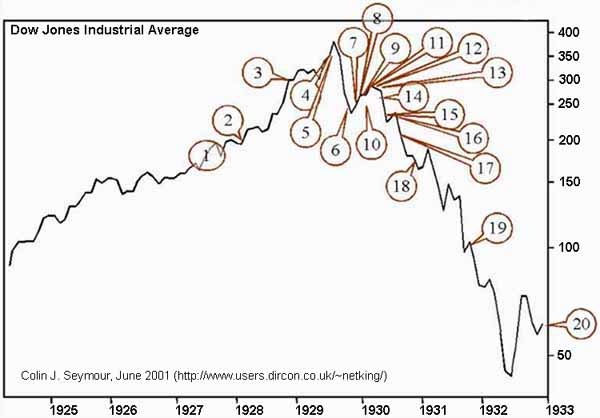
The following is an interesting look at the statements of the best and brightest experts and economists during the Great Depression of 1929. It is amusing to see how wrong their statements proved to be in hindsight. This further underscores the importance of not trying to predict market movements and instead to identify good companies trading at sufficient margins of safety to their real value.

Courtesy Colin Seymour

For relvance to 2001, scroll down to "Fast forward"

1.

"We will not have any more crashes in our time."
- John Maynard Keynes in 1927 [NB: The authenticity of this one is a little suspect]

2.

"I cannot help but raise a dissenting voice to statements that we are living in a fool's paradise, and that prosperity in this country must necessarily diminish and recede in the near future."
- E. H. H. Simmons, President, New York Stock Exchange, January 12, 1928

"There will be no interruption of our permanent prosperity."
- Myron E. Forbes, President, Pierce Arrow Motor Car Co., January 12, 1928

3.

"No Congress of the United States ever assembled, on surveying the state of the Union, has met with a more pleasing prospect than that which appears at the present time. In the domestic field there is tranquility and contentment...and the highest record of years of prosperity. In the foreign field there is peace, the goodwill which comes from mutual understanding."
- Calvin Coolidge December 4, 1928

4.

"There may be a recession in stock prices, but not anything in the nature of a crash."
- Irving Fisher, leading U.S. economist, New York Times, Sept. 5, 1929

5.

"Stock prices have reached what looks like a permanently high plateau. I do not feel there will be soon if ever a 50 or 60 point break from present levels, such as (bears) have predicted. I expect to see the stock market a good deal higher within a few months."
- Irving Fisher, Ph.D. in economics, Oct. 17, 1929

"This crash is not going to have much effect on business."
- Arthur Reynolds, Chairman of Continental Illinois Bank of Chicago, October 24, 1929

"There will be no repetition of the break of yesterday... I have no fear of another comparable decline."
- Arthur W. Loasby (President of the Equitable Trust Company), quoted in NYT, Friday, October 25, 1929

"We feel that fundamentally Wall Street is sound, and that for people who can afford to pay for them outright, good stocks are cheap at these prices."
- Goodbody and Company market-letter quoted in The New York Times, Friday, October 25, 1929

6.

"This is the time to buy stocks. This is the time to recall the words of the late J. P. Morgan... that any man who is bearish on America will go broke. Within a few days there is likely to be a bear panic rather than a bull panic. Many of the low prices as a result of this hysterical selling are not likely to be reached again in many years."
- R. W. McNeel, market analyst, as quoted in the New York Herald Tribune, October 30, 1929

"Buying of sound, seasoned issues now will not be regretted"
- E. A. Pearce market letter quoted in the New York Herald Tribune, October 30, 1929

"Some pretty intelligent people are now buying stocks... Unless we are to have a panic -- which no one seriously believes, stocks have hit bottom."
- R. W. McNeal, financial analyst in October 1929

7.

"The decline is in paper values, not in tangible goods and services...America is now in the eighth year of prosperity as commercially defined. The former great periods of prosperity in America averaged eleven years. On this basis we now have three more years to go before the tailspin."
- Stuart Chase (American economist and author), NY Herald Tribune, November 1, 1929

"Hysteria has now disappeared from Wall Street."
- The Times of London, November 2, 1929

"The Wall Street crash doesn't mean that there will be any general or serious business depression... For six years American business has been diverting a substantial part of its attention, its energies and its resources on the speculative game... Now that irrelevant, alien and hazardous adventure is over. Business has come home again, back to its job, providentially unscathed, sound in wind and limb, financially stronger than ever before."
- Business Week, November 2, 1929

"...despite its severity, we believe that the slump in stock prices will prove an intermediate movement and not the precursor of a business depression such as would entail prolonged further liquidation..."
- Harvard Economic Society (HES), November 2, 1929

8.

"... a serious depression seems improbable; [we expect] recovery of business next spring, with further improvement in the fall."
- HES, November 10, 1929

"The end of the decline of the Stock Market will probably not be long, only a few more days at most."
- Irving Fisher, Professor of Economics at Yale University, November 14, 1929

"In most of the cities and towns of this country, this Wall Street panic will have no effect."
- Paul Block (President of the Block newspaper chain), editorial, November 15, 1929

"Financial storm definitely passed."
- Bernard Baruch, cablegram to Winston Churchill, November 15, 1929

9.

"I see nothing in the present situation that is either menacing or warrants pessimism... I have every confidence that there will be a revival of activity in the spring, and that during this coming year the country will make steady progress."
- Andrew W. Mellon, U.S. Secretary of the Treasury December 31, 1929

"I am convinced that through these measures we have reestablished confidence."
- Herbert Hoover, December 1929

"[1930 will be] a splendid employment year."
- U.S. Dept. of Labor, New Year's Forecast, December 1929

10.

"For the immediate future, at least, the outlook (stocks) is bright."
- Irving Fisher, Ph.D. in Economics, in early 1930

11.

"...there are indications that the severest phase of the recession is over..."
- Harvard Economic Society (HES) Jan 18, 1930

12.

"There is nothing in the situation to be disturbed about."
- Secretary of the Treasury Andrew Mellon, Feb 1930

13.

"The spring of 1930 marks the end of a period of grave concern...American business is steadily coming back to a normal level of prosperity."
- Julius Barnes, head of Hoover's National Business Survey Conference, Mar 16, 1930

"... the outlook continues favorable..."
- HES Mar 29, 1930

14.

"... the outlook is favorable..."
- HES Apr 19, 1930

15.

"While the crash only took place six months ago, I am convinced we have now passed through the worst -- and with continued unity of effort we shall rapidly recover. There has been no significant bank or industrial failure. That danger, too, is safely behind us."
- Herbert Hoover, President of the United States, May 1, 1930

"...by May or June the spring recovery forecast in our letters of last December and November should clearly be apparent..."
- HES May 17, 1930

"Gentleman, you have come sixty days too late. The depression is over."
- Herbert Hoover, responding to a delegation requesting a public works program to help speed the recovery, June 1930

16.

"... irregular and conflicting movements of business should soon give way to a sustained recovery..."
- HES June 28, 1930

17.

"... the present depression has about spent its force..."
- HES, Aug 30, 1930

18.

"We are now near the end of the declining phase of the depression."
- HES Nov 15, 1930

19.

"Stabilization at [present] levels is clearly possible."
- HES Oct 31, 1931

20.

"All safe deposit boxes in banks or financial institutions have been sealed... and may only be opened in the presence of an agent of the I.R.S."
- President F.D. Roosevelt, 1933

Fast forward... year 2001

Thursday, July 17, 2008

When to Sell a Stock

Many investors buy stocks with pre-defined sell triggers in mind. "I'll sell the stock in 1 year", "I'll sell the stock once it gives me a 50% return", "I'll sell it when it once the current acquisition plan is finalised", etc.

Value investors, however, look at selling stock holdings in a very different way. To value investors, there are only 3 reasons to sell stocks:

1. The valuation becomes too expensive. eg: the stock was trading at a P/E of 10 at the time of purchase. After 2 years of patient holding, the stock has now reached P/E of 20, which is much higher than the historical average for the company, as well as higher than the industry average. Time to Sell!

2. The original investment case is no longer valid. eg: Mr. A invests in a stock in the real estate industry, because he believes that the then benign interest rate scenario is very favourable for the real estate industry. However, the rate cycle eventually turns and rates end up becoming high enough to begin to hit real estate sales. Clearly, the original investment case (Low interest rates = good time for real estate stocks) is no longer valid. Time to Sell!

3. A better opportunity comes along. eg: Mr. A decides to invest in an auto stock because he believes that as India's middle class gets higher disposable incomes, the demand for automobiles is going to rise exponentially. However, after looking at the value chain of the auto industry, he feels (rightly or wrongly) that rather than the auto manufacturers, certain auto component manufacturers are the ones who are actually cornering most of the profit margins in the industry's growth. Time to exit auto & enter auto components.

Tuesday, July 8, 2008

Prospect Theory

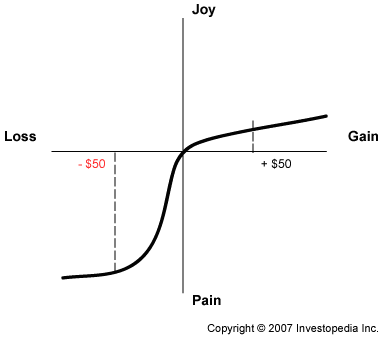
Prospect Theory is the foundation of the field of economics and finance which has now become popular as Behavioural Economics/ Behavioural Finance.

Economists Daniel Kahneman and Amos Tversky developed the concept of Prospect Theory in 1979 after an empirical study of the how individuals choose between alternatives in the presence of risk.Prospect Theory is a very useful framework to describe how investors respond to gains and losses in the markets. In the most simplistic form, prospect theory can be described by the function shown in the graph above. It states that the pain felt by individuals when they incur losses is twice the pleasure felt when they secure gains.

Applied to the field of investing, the theory states that investors value gains and losses differently, i.e. the emotional impact of losses is much higher than the emotional high of gains.

When it was formulated, Prospect Theory was completely against the prevailing consensus of the time, viz. economic agents are rational and treat losses and gains equally, and try to maximise their potential gains in all decision making. Prospect theory states that the emotional impact of potential losses causes significant changes in investor behaviour and thus affects decisions to buy and sell, and hence future returns.

Further research based on Prospect Theory has revealed a number of behavioural biases, which affect economic returns. We shall cover some of these in future posts. An awareness of these biases will help to prevent very obvious errors in investing, such as Confirmation Basis, Anchoring, Hindsight bias, etc. While, it is very difficult to avoid succumbing to these biases, it is worthwhile to keep a list of all these biases in front of oneself while evaluating investment decisions.

Friday, May 2, 2008

Well known value investors : Benjamin Graham is regarded as the father of value investing.

Benjamin Graham is regarded by many to be the father of value investing. Along with David Dodd, he wrote Security Analysis, first published in 1934. The most lasting contribution of this book to the field of security analysis was to emphasize the quantifiable aspects of security analysis (such as the evaluations of earnings and book value) while minimizing the importance of more qualitative factors such as the quality of a company's management. Graham later wrote The Intelligent Investor, a book that brought value investing to individual investors. Aside from Buffett, many of Graham's other students, such as William J. Ruane, Irving Kahn and Charles Brandes have gone on to become successful investors in their own right.

Graham's most famous student, however, is Warren Buffett, who ran successful investing partnerships before closing them in 1969 to focus on running Berkshire Hathaway. Charlie Munger joined Buffett at Berkshire Hathaway in the 1970s and has since worked as Vice Chairman of the company. Buffett has credited Munger with encouraging him to focus on long-term sustainable growth rather than on simply the valuation of current cash flows or assets.[7] Columbia Business School has played a significant role in shaping the principles of the Value Investor, with Professors and students making their mark on history and on each other. Ben Graham’s book, The Intelligent Investor, was Warren Buffett’s bible and he referred to it as "the greatest book on investing ever written.” A young Warren Buffett studied under Prof. Ben Graham, took his course and worked for his small investment firm, Graham Newman, from 1954 to 1956. Twenty years after Ben Graham, Prof. Roger Murray arrived and taught value investing to a young student named Mario Gabelli. About a decade or so later, Prof. Bruce Greenwald arrived and produced his own protégés, including Mr. Paul Sonkin - just as Ben Graham had Mr. Buffett as a protégé, and Roger Murray had Mr. Gabelli.


-Source (Web)