Click the picture below to access parent website : www.hbjcapital.com / www.hbjcapital.in

Click the picture below to access parent website : www.hbjcapital.com / www.hbjcapital.in
Call : 09886736791 / 9677088836 (Multibagger) / 9818866676 (Penny) / 9886403791 (Trading)
Showing posts with label Behavioural Investing. Show all posts

Sunday, April 18, 2010

Nouriel Roubini & the Stock Market

The original idea for this post came from Ekonomiturk

Of late, Nouriel Roubini has been called a perma-bear by many people, and hence he has got knocked down few notches from the pedestal of Market Oracle where he had been placed in the wake of the Great Recession of 2008-09.

However, a new chart (shown below) seems to suggest that Nouriel Roubini does have the ability to predict market movements even when the general trend of the market is upwards. It is just that these predictions are quite unintentional. Mr. Roubini seems to be providing cues on when to buy and sell stocks in the market.

The good folks at Ekonomiturk have put out a chart which compares the popularity of the search keyword 'Nouriel Roubini' on Google (through Google trends) and the gyrations of the S&P 500. It seems that their movements are negatively correlated. i.e. when the market starts to take a breather and corrects after a few days of rising, the public starts to seek out Nouriel Roubini, to see whether the most recent crash is likely to lead to a double-dip recession and a harrowing market crash.

As soon as the correction ends, and the upward trend resumes, Mr. Roubini's popularity on Google crashes with the force of waves crashing into Marine Drive during the monsoons.

Here's the graph.


As a value investor, I try to avoid making my investment decisions based on such indicators, but it is a fun way to understand investor behaviour. I would file this post under my 'Behavioural Investing' bookshelf.

Sunday, September 6, 2009

Confirmation Bias

Confirmation bias is the cognitive bias due to which investors tend to seek out information that supports their preferences and ideas, while tending to subconsciously ignore information which negates their conclusions. Consequently, investors end up investing in situations which are not completely ideal.

For example, consider an investor who is looking to invest in the renewable energy space and thinks that Company 'X' might be a good stock to buy. He looks at the projected growth of the wind power industry, the forecasts for high oil prices which re-inforce his view that wind power is a high growth industry, and also looks at X's rapid growth and order book. He reaches the conclusion that X definitely an idea worth investing.

While he is still conducting his research, he has become emotionally invested in the idea due to the amount of time he has spent researching X. Now he encounters an article which suggests that while X very good prospects, its debt burden is a problem. The interest outgo as well is a strain on its financials, and is likely to impact earnings, which in turn will impact the stock price.

This is where confirmation bias kicks in. Due to his emotional commitment and the amount of previous research he has done, he is convinced that the possibility of the debt burden leading to financial difficulties is limited and hence he dismisses the issue.

The end result is a bad investment which comes back to bit our investor when the market sentiment shifts and the investment community starts to fret over X's debt burden. This is a recipe for a dramatic stock price collapse.

Friday, August 8, 2008

Behavioural Investing: Anchoring

A building needs to be be built on a solid foundation, a theory must be built on solid arguments, and an investment decision must be built on solid analysis. However, investors often make investment decisions which are built not on solid analysis, but "anchored" on reference point. How does this impact returns enjoyed by investors? In the following paragraphs, we investigate.

Imagine that Mr. A purchased stock in company 'A' for Rs 100 per share. The stock steadily rises to Rs 150 over a period of a year. Unfortunately, as it turns out, the company derives 50% of its sales from its license of a fast-selling software product. Suddenly, the licensor decides to withdraw the license and enter the market on its own. The stock tanks as soon as the news breaks and hits 110. However, Mr. A sees that the stock is off its high of 150 and hence erroneously assumes it is undervalued, and purchases more stocks.

However, the company's fundamentals have clearly deteriorated, with no immediate hope of maintaining its earnings, unless it is able to take some radical steps. Thus, by falling victim to 'Anchoring Bias', Mr. A has compounded his loss.

Anchoring also works in another way. Since, even at Rs 110, the stock is above Mr. A's purchase price, he still has an illusory feeling that he is in the money. Hence, he continues to hold/ or even increases his position in the stock. Thus, instead of redeploying his money in a company with better fundamentals, he is continues to suffer from the consequences of his behavioural biases
.

Tuesday, July 8, 2008

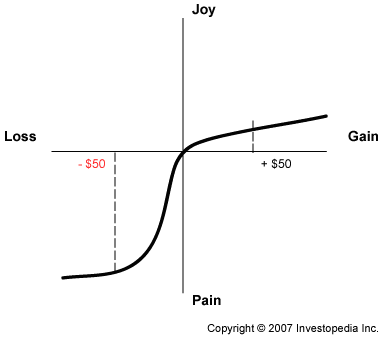
Prospect Theory

Prospect Theory is the foundation of the field of economics and finance which has now become popular as Behavioural Economics/ Behavioural Finance.

Economists Daniel Kahneman and Amos Tversky developed the concept of Prospect Theory in 1979 after an empirical study of the how individuals choose between alternatives in the presence of risk.Prospect Theory is a very useful framework to describe how investors respond to gains and losses in the markets. In the most simplistic form, prospect theory can be described by the function shown in the graph above. It states that the pain felt by individuals when they incur losses is twice the pleasure felt when they secure gains.

Applied to the field of investing, the theory states that investors value gains and losses differently, i.e. the emotional impact of losses is much higher than the emotional high of gains.

When it was formulated, Prospect Theory was completely against the prevailing consensus of the time, viz. economic agents are rational and treat losses and gains equally, and try to maximise their potential gains in all decision making. Prospect theory states that the emotional impact of potential losses causes significant changes in investor behaviour and thus affects decisions to buy and sell, and hence future returns.

Further research based on Prospect Theory has revealed a number of behavioural biases, which affect economic returns. We shall cover some of these in future posts. An awareness of these biases will help to prevent very obvious errors in investing, such as Confirmation Basis, Anchoring, Hindsight bias, etc. While, it is very difficult to avoid succumbing to these biases, it is worthwhile to keep a list of all these biases in front of oneself while evaluating investment decisions.